
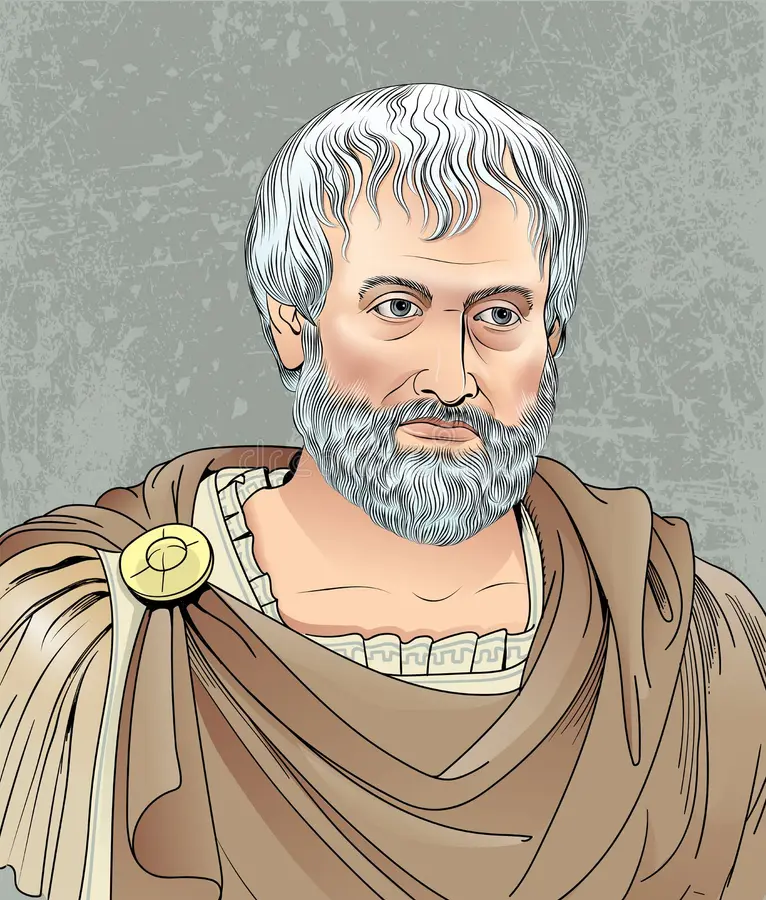
Aristotle (384–322 BCE) was a Greek philosopher and polymath whose ideas laid the foundation for Western philosophy and science. A student of Plato and teacher of Alexander the Great, Aristotle’s work spanned a wide range of subjects including logic, ethics, metaphysics, biology, and politics.
Often regarded as one of the most influential thinkers in history, Aristotle’s ideas continue to shape modern disciplines, from philosophy and political theory to natural sciences and psychology.
Early Life and Education of Aristotle
Aristotle was born in Stagira, a city in northern Greece. His father, Nicomachus, was a physician to the Macedonian royal family, which may have influenced Aristotle’s interest in biology and empirical observation.
At the age of 17, Aristotle moved to Athens to study at Plato’s Academy, where he remained for about 20 years. While deeply influenced by Plato, Aristotle developed his own distinct philosophical ideas, often diverging sharply from his teacher’s theories.
Aristotle’s Major Contributions to Philosophy
1. Logic and the Syllogism
Aristotle is considered the father of formal logic. He introduced the concept of the syllogism, a form of reasoning where conclusions are drawn from two premises. His logical works, especially the Organon, formed the basis of deductive reasoning for centuries.
2. Ethics and the Golden Mean
In his seminal work Nicomachean Ethics, Aristotle introduced the idea of virtue ethics, arguing that moral virtue lies between two extremes — the doctrine of the Golden Mean. For example, courage is a virtue between the extremes of cowardice and recklessness.
3. Metaphysics
Aristotle’s Metaphysics deals with the nature of reality, being, and existence. He introduced key philosophical concepts such as substance, form and matter, potentiality and actuality, and the Unmoved Mover, a foundational idea in theology and cosmology.
4. Political Philosophy
In Politics, Aristotle analyzed different political systems and advocated for a constitutional government — a middle path between oligarchy and democracy. He emphasized the role of the polis (city-state) and the idea of humans as “political animals.”
Aristotle’s Scientific Legacy
Aristotle made lasting contributions to biology, zoology, and natural science. Unlike his contemporaries, he based his studies on empirical observation, dissecting animals and categorizing them based on their characteristics.
He also wrote extensively on physics, although many of his theories were later revised or replaced during the Scientific Revolution. Still, his method of observation and classification laid the groundwork for the scientific method.
Influence on Western Thought of Aristotle
Aristotle’s influence extended through the Middle Ages, especially in Islamic and Christian philosophy. Thinkers like Aquinas, Averroes, and Avicenna engaged deeply with his works.
During the Renaissance and the Enlightenment, Aristotle’s ideas were revived and debated, solidifying his place in both secular philosophy and religious thought.
His logic remained unchallenged until the 19th century, and many of his ethical and political theories are still discussed in modern academic circles.
Aristotle vs. Plato: Key Differences
| Topic | Plato | Aristotle |
|---|---|---|
| Reality | Believed in abstract Forms | Believed in tangible substances |
| Knowledge | Innate ideas, rationalism | Empirical observation |
| Politics | Ideal state ruled by philosophers | Constitutional government |
| Ethics | Based on ideal Forms | Based on practical virtue |
This comparison highlights how Aristotle grounded his philosophy in the real, observable world, unlike Plato’s more abstract, idealist approach.
Legacy and Impact Today
Aristotle’s works continue to be studied across disciplines. His philosophy informs:
- Modern ethics
- Political science
- Psychology
- Scientific methodology
- Rhetoric and communication studies
Whether you are studying logic, debating moral philosophy, or exploring political theory, Aristotle’s ideas remain remarkably relevant.
Conclusion: Why Aristotle Still Matters
Aristotle was more than just a philosopher — he was a visionary thinker who sought to understand the world through reason, observation, and systematic inquiry. His holistic approach to knowledge has made him a pillar of both ancient wisdom and modern intellectual thought. read more